Overtone
Roland Xps 30 Version 2.11 Jun 2026
: Resolved a bug where the unit failed to function correctly when the "Sync Mode" was set to in the system settings. Keyboard Split Constraints
: Includes an 8-track pattern sequencer, a mic input with dedicated vocal effects (vocoder/auto-pitch), and physical sliders for real-time sound manipulation. The Verdict roland xps 30 version 2.11
The Roland XPS-30 is a compact performance workstation combining PCM/Rhythm sounds, effects, and easy layering/splitting for live play. Version 2.11 adds firmware stability and minor usability tweaks (patch handling and MIDI improvements). This guide covers setup, navigation, sound creation, performance techniques, MIDI/DAW integration, basic troubleshooting, and useful tips. : Resolved a bug where the unit failed
You can load your own WAV or AIFF samples (mono/stereo, 16/24-bit, 44.1kHz) via USB. These can be mapped across the keyboard, creating custom drum kits or sound effects. Version 2.11 ensures this process no longer intermittently fails on high-capacity USB drives. Version 2
The Roland XPS-30 is a portable, versatile synthesizer that combines the features of a workstation and a synthesizer. It's designed for music production, performance, and education.
Roland XPS-30 Version 2.11: The Mature Workhorse That Keeps Getting Smarter
Wave expansion slot for free sounds from the Roland Axial website Eight phrase pads for triggering samples and audio songs Sequencer Intuitive 8-track pattern sequencer with non-stop recording Portability Lightweight design with battery power option Support - XPS-30 - Updates & Drivers - Roland
Examples
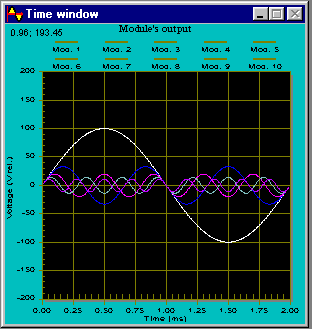
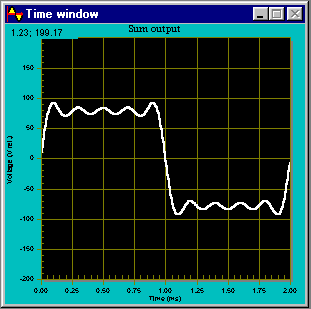
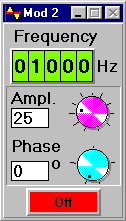
You can test the Helmholtz assumption that the relative phases of the overtones are irrelevant to hearing.
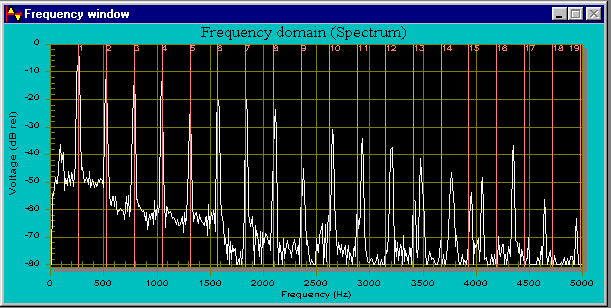
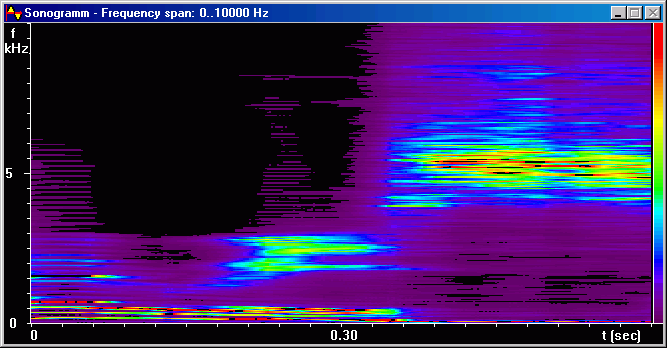
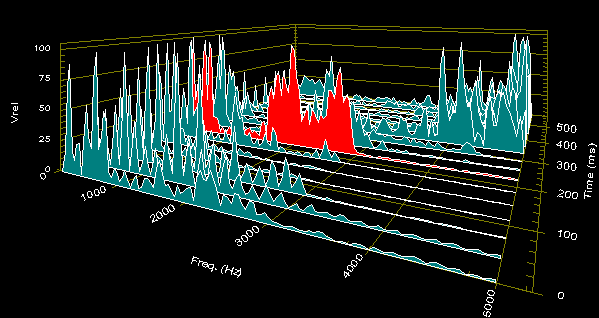
In analyser experiments you capture sound from the sound card or from a WAV file up to several seconds long, select the starting time of the time slice and analyse time and frequency responses. The example shows the spectrum of a piano playing a middle C (262 Hz). The non-harmonic overtones are clearly seen. (Due to the stiffness of the string, the frequencies of the partials are too high.)
Download version 1.15, June 2009: OVERTONE.ZIP
(1.55 MB)
Unpack in a new folder, read README.TXT and start OVERTONE.EXE
(Some firewalls or User Access Control (UAC) may block execution. Give OVERTONE the necessary permissions.
Make sure, that the sound device is not used by another application.)
For more information, send e-mail to address given in README.TXT
Unterrichtseinheit Analyse von Klangspektren von Alain Hauser (in German)
