From Photo to String Art
Drop your image here
or click to browse files
Upload any image and watch it transform into a stunning thread-based masterpiece. Perfect for artists, crafters, and anyone who loves unique wall art.
From Photo to String Art
Drop your image here
or click to browse files
Simply drag & drop or select any image from your device. Works with portraits, landscapes, pets, and more
Our advanced algorithm analyzes your image and creates the perfect string art pattern with optimal thread placement
Follow the step-by-step guide to create your physical string art masterpiece with the generated pin sequence.
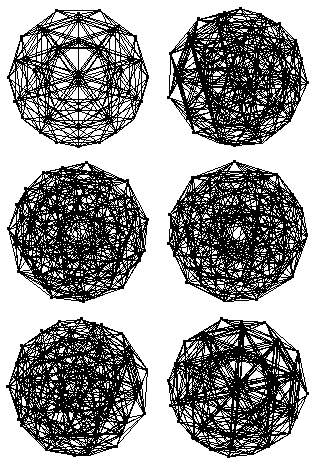
String art is a geometric art form that creates stunning visual patterns using only threads or strings wrapped around nails or pins placed on a board. This nail and string art technique, also known as pin and thread art, transforms simple materials into complex, beautiful designs through mathematical precision and artistic vision.
Originally developed in the 1960s by mathematician Mary Everest Boole, modern string art has evolved to incorporate advanced continuous line algorithms that optimize thread placement for maximum visual impact. Our string art generator utilizes sophisticated computational methods to analyze your photos and generate precise nail-to-nail sequences, making it accessible for both beginners exploring string art ideas and experienced artists creating professional string art patterns.
Whether you're working with traditional string art kits or creating custom string art designs, this ancient craft combines mathematical precision with artistic expression, resulting in unique wall art that captures light and shadow in remarkable ways.
Shinto and Buddhist influences permeate these mediums. The prevalence of yokai (spirits) in franchises like Pokémon or Spirited Away reflects the animistic worldview that nature is imbued with spirit. Visually, anime utilizes "superflat" aesthetics—minimal depth perception and emphasis on outlines—which draws from traditional woodblock printing ( Ukiyo-e ), creating a distinct artistic lineage.
The Japanese entertainment industry stands as a unique paradox in the global market: it is deeply insular, often prioritizing domestic tastes, yet it exerts a profound influence on global pop culture. From the aesthetic philosophies of the Edo period to the neon-lit futurism of Cyberpunk anime, Japanese media offers a distinct narrative style that differentiates it from Western counterparts, particularly Hollywood. This paper posits that the success of Japanese entertainment lies in its ability to syncretize traditional cultural elements with modern technology, creating a product that is both authentically Japanese and universally appealing.
Dramas ( Dorama ) like Hanzawa Naoki pull massive ratings, but they are event-driven (10-12 episodes per season, no second seasons unless the manga continues). Meanwhile, streaming (Netflix, U-Next) is growing, producing hits like Alice in Borderland , but TV Asahi and Nippon TV still dictate the national conversation.
The Japanese music industry is one of the largest and most influential in the world. J-Pop (Japanese Pop) and J-Rock (Japanese Rock) are two of the most popular genres, with artists like AKB48, Arashi, and Perfume achieving huge success both domestically and internationally. Traditional Japanese music, such as enka (ballads) and classical music, also continue to be popular.
The Japanese entertainment industry is a massive economic force, with the movie and entertainment market alone valued at approximately and projected to grow significantly by 2033 according to Grand View Research. This industry is deeply intertwined with Japanese culture, blending ancient traditions with modern technology. Global Media Powerhouses
Using Japanese pop cultural heritage to create a tourist product
The Japanese content industry was valued at approximately $43 billion in 2024, making it the country's most successful export industry after automobiles .


Shinto and Buddhist influences permeate these mediums. The prevalence of yokai (spirits) in franchises like Pokémon or Spirited Away reflects the animistic worldview that nature is imbued with spirit. Visually, anime utilizes "superflat" aesthetics—minimal depth perception and emphasis on outlines—which draws from traditional woodblock printing ( Ukiyo-e ), creating a distinct artistic lineage.
The Japanese entertainment industry stands as a unique paradox in the global market: it is deeply insular, often prioritizing domestic tastes, yet it exerts a profound influence on global pop culture. From the aesthetic philosophies of the Edo period to the neon-lit futurism of Cyberpunk anime, Japanese media offers a distinct narrative style that differentiates it from Western counterparts, particularly Hollywood. This paper posits that the success of Japanese entertainment lies in its ability to syncretize traditional cultural elements with modern technology, creating a product that is both authentically Japanese and universally appealing.
Dramas ( Dorama ) like Hanzawa Naoki pull massive ratings, but they are event-driven (10-12 episodes per season, no second seasons unless the manga continues). Meanwhile, streaming (Netflix, U-Next) is growing, producing hits like Alice in Borderland , but TV Asahi and Nippon TV still dictate the national conversation.
The Japanese music industry is one of the largest and most influential in the world. J-Pop (Japanese Pop) and J-Rock (Japanese Rock) are two of the most popular genres, with artists like AKB48, Arashi, and Perfume achieving huge success both domestically and internationally. Traditional Japanese music, such as enka (ballads) and classical music, also continue to be popular.
The Japanese entertainment industry is a massive economic force, with the movie and entertainment market alone valued at approximately and projected to grow significantly by 2033 according to Grand View Research. This industry is deeply intertwined with Japanese culture, blending ancient traditions with modern technology. Global Media Powerhouses
Using Japanese pop cultural heritage to create a tourist product
The Japanese content industry was valued at approximately $43 billion in 2024, making it the country's most successful export industry after automobiles .
This string art patterns generator builds upon the pioneering work of the open-source community and mathematical research in computational geometry:
MIT License - This project is open source and available under the MIT License.
Source Code: Available on GitHub Pages with full source transparency
Attribution: When sharing or modifying, please credit StringAr.com and maintain license notices
Commercial Use: Permitted under MIT terms - feel free to use for commercial string art projects
Our enhancements to the original algorithms include: